
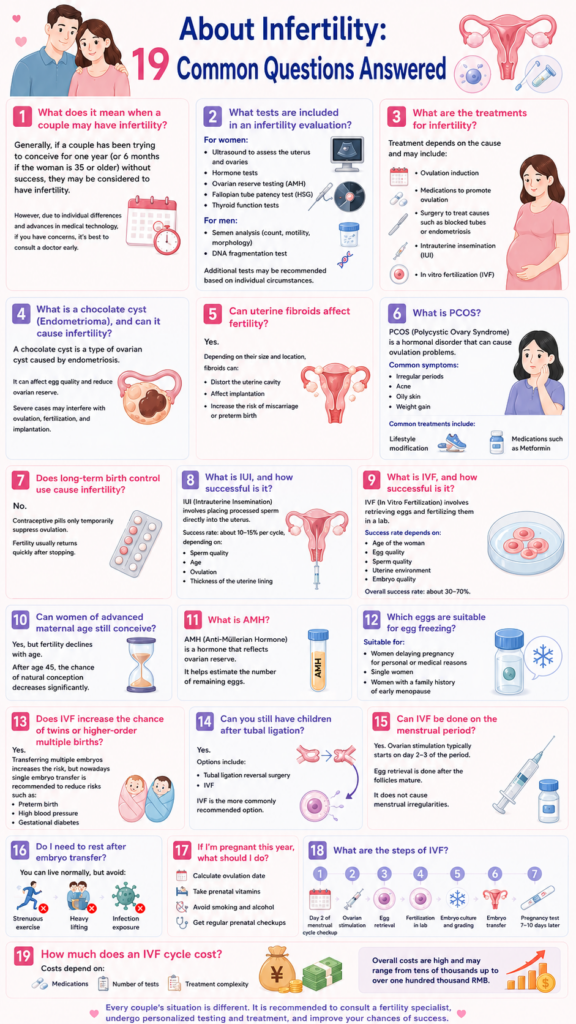
1. What indicates that a couple may have infertility problems?
Infertility is generally defined as a couple being unable to conceive after 1 year of regular unprotected intercourse (at least twice a week). However, with modern fertility evaluations, doctors may identify infertility-related conditions earlier, such as poor sperm quality, so couples may not need to wait a full year before seeking evaluation.
2. What tests are used to diagnose infertility?
Female evaluations include:
Ultrasound to detect abnormalities in the uterus and ovaries
Hysteroscopy to check for uterine polyps or adhesions
Hysterosalpingography (HSG) to examine fallopian tube blockage
Male evaluations include:
Semen analysis to assess sperm count, movement, and morphology
DNA Fragmentation testing to evaluate sperm DNA integrity
Additional specialized tests may be recommended depending on medical history.
3. What are the treatment options for infertility?
Treatment depends on the cause of infertility and previous treatment history.
Possible treatments include:
Ovulation tracking
Oral ovulation stimulation medications
Surgery for ovarian cysts, uterine fibroids, or uterine polyps
4. How does a chocolate cyst (endometrioma) affect fertility?
Chocolate cysts are caused by endometriosis, where uterine lining tissue grows outside the uterus and affects the ovaries. This condition can reduce egg quality, decrease ovarian reserve after surgery, and lower implantation success.
5. Do uterine fibroids affect fertility?
Yes, depending on their size, number, and location. Fibroids may interfere with embryo implantation or increase miscarriage risk. Surgery may be recommended if fibroids significantly affect fertility.
6. What is PCOS?
Polycystic Ovary Syndrome (PCOS) is a hormonal disorder causing irregular ovulation. Symptoms may include acne, oily skin, excessive hair growth, and irregular periods. Ultrasound often shows multiple small follicles around the ovaries.
Treatment commonly includes:
Weight management
Lifestyle changes
Metformin medication
7. Does long-term birth control pill use cause infertility?
No. Birth control pills temporarily prevent ovulation, but fertility generally returns after stopping the medication.
8. How successful is IUI?
IUI involves placing prepared sperm directly into the uterus during ovulation. Average success rates are approximately 10–15% per cycle, depending on sperm quality, egg development, and uterine lining thickness.
9. What is the success rate of IVF?
IVF success rates vary widely depending on:
Female age
Sperm quality
Egg quality
Uterine condition
Embryo quality
Genetic testing results
Success rates may range from 0–70%.
10. What age can women undergo IVF?
Women who are still ovulating or menstruating may undergo IVF, but success rates decline significantly with age, especially after age 45.
11. What is AMH?
AMH (Anti-Müllerian Hormone) is a blood test used to estimate ovarian reserve and predict the number of eggs that may respond to ovarian stimulation.
12. Who should consider egg freezing?
Egg freezing may benefit:
Women undergoing chemotherapy or radiation
Women delaying marriage or pregnancy
Women with a family history of early menopause
13. Can IVF help achieve twin pregnancy?
Yes. Transferring two embryos may increase the chance of twins. However, twin pregnancies carry higher risks such as premature birth, preeclampsia, and gestational diabetes.
14. Can people have children after sterilization?
Yes. Pregnancy may still be possible through:
Sterilization reversal surgery
IVF using eggs or sperm retrieved directly from reproductive organs
15. Is IVF painful?
IVF involves hormone injections and egg retrieval under anesthesia. Mild abdominal discomfort may occur afterward, but embryo transfer is generally not very painful.
16. Should patients rest after embryo transfer?
Light daily activities are generally allowed, but heavy lifting, excessive walking, and infections should be avoided.
17. How can someone increase the chance of pregnancy this year?
Track ovulation accurately
Have intercourse during fertile days
Seek fertility evaluation early if pregnancy does not occur naturally
18. What are the steps involved in IVF?
Hormone testing and ultrasound
Ovarian stimulation injections
Egg retrieval
Fertilization with sperm
Embryo culture and freezing
Embryo transfer
Pregnancy testing 7–10 days later
19. How much does IVF cost?
IVF costs vary depending on medications and infertility complexity. In many cases, treatment costs can reach several thousand dollars or more.

Appointment
iBaby Fertility & Genetic Center
11 Floor, Athenee Tower, Wittayu Road
Mon – Sat 9 am – 4 pm
More Information
Tel : +6621688640
Tel : +6621688641
Tel : +6621688642
Tel : +6621688643
Mail : info@iBabyFertility.com
Line : @iBaby
